

Don't want to trade it yourself?
Our desk runs DEX portfolios on profit share.

DeFi Planet2026/02/03 12:24
By:DeFi Planet
Bitget offers one-stop trading for cryptocurrencies, stocks, and gold.Trade now!
A welcome pack worth 6200 USDT for new users!Sign up now!
Last updated on February 3rd, 2026 at 01:23 pm
As DeFi grows in scale and complexity, so do its risks. High yields and borderless innovation often come hand-in-hand with vulnerabilities such as smart contract exploits, protocol failures, and stablecoin depegging. To mitigate these threats, a new frontier of protection has emerged:DeFi insurance platforms.
In this article, we’ll unpack everything you need to know about usingDeFi insurance protocols,from how it works, what it covers, and which platforms lead the space, to its benefits, limitations, and practical use.
What is DeFi Insurance?
DeFi insurance, short for decentralized finance insurance, is a <a href="https://xpertsstudio.com/da-shan-on-blockchain-100-ai-in-the-left-hand-crypto-in-the-right/” title=”Da Shan on "Blockchain 100": AI in the Left Hand, Crypto in the Right”>blockchain-based protection mechanism that helps users hedge against specific risks within the DeFi ecosystem. Unlike traditional insurance, which is operated by centralized companies with underwriters and adjusters,DeFi insurance protocolsrely on smart contracts and decentralized liquidity pools to manage claims, payouts, and policy decisions.
DeFi insurance is simply a decentralized safety net that provides peace of mind in a space defined by rapid experimentation and risk.
Types of Risks Covered by DeFi Insurance
The DeFi space carries unique risks not usually covered by traditional insurance providers. Here are theprimary categories of risks DeFi insurance protocols focus on:
1. Smart contract vulnerabilities
Most DeFi platforms rely on smart contracts to manage funds and automate transactions. A flaw in the code can be catastrophic. Insurance covers losses stemming from exploits or bugs in these contracts.
2. Protocol and exchange hacks
Major DeFi platforms and exchanges often hold millions in total value locked (TVL), making them prime targets for cyberattacks. Some insurance policies compensate users if a covered protocol suffers a security breach.
3. Stablecoin depegging
Many DeFi strategies involve stablecoins pegged to fiat currencies (e.g., USDC, DAI). If a stablecoin loses its peg, users can incur serious losses. Insurance can reimburse these losses when the depegging surpasses a certain threshold.
How DeFi Insurance Works
At its core,DeFi insurance protocolsreplace centralized insurance companies with smart contracts and liquidity pools. Here’s how it functions:
1. Risk pooling through decentralized capital
Users (often called liquidity providers or underwriters) deposit capital into insurance pools. These funds are used to pay out valid claims. In return, liquidity providers earn yield or governance tokens.
2. Policy purchase
Users can browse supported DeFi protocols and purchase insurance coverage for a specified duration and amount. Premiums vary based on risk, pool liquidity, and market conditions.
3. Claims processing
Claims can be handled in two ways:
- Parametric Claims
: If predefined conditions are met (e.g., stablecoin falls below $0.90 for 24 hours), a payout is automatically triggered. - Discretionary Claims
: Users submit claims for review, and governance participants vote on validity.
4. Payouts
Once a claim is approved, either algorithmically orto the insured wallet
Key Technologies:
- Smart Contracts
: Automate premiums, coverage terms, and claims. - Oracles
: Feed real-world data into smart contracts. - DAOs
: Community-led governance manages rules, risk parameters, and claim approvals.
Top DeFi Insurance Platforms
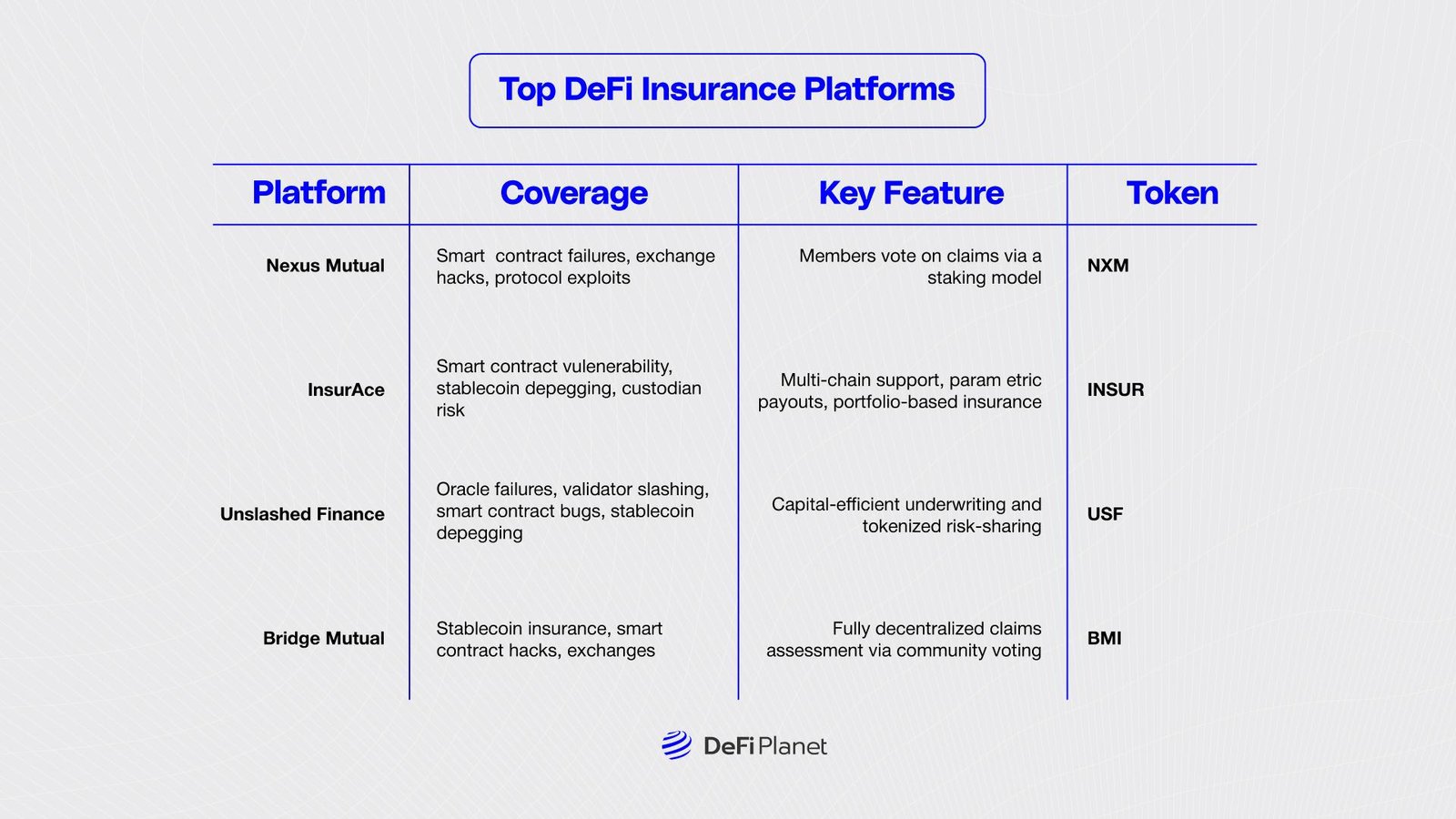
As DeFi continues to grow, a number ofDeFi insurance platformshave emerged to address the risks associated with smart contracts, stablecoins, and other crypto assets. These platforms vary in terms of coverage, governance models, and technical infrastructure. Below are some of the leading names shaping theDeFi insurance protocolslandscape:
1. Nexus Mutual
It is a DeFi insurance provider that offers a decentralized alternative to traditional insurance models, specifically for
Ethereum users
. It allows members to buy coverage that protects against substantial losses resulting from smart contract failures, protocol exploits, or custodial risks. One of its standout features is a community-based claims process, where members vote on claims using a staking model. The native token, NXM, is used for both governance and underwriting. Nexus Mutual is known for its broad protocol coverage and strong reputation within the DeFi ecosystem.
2. InsurAce
It offers a multi-chain insurance solution with a wide range of coverage options, including smart contract vulnerabilities, stablecoin depegging, and risks associated with custodians. It supports portfolio-based insurance and utilizes parametric payout mechanisms, making the claims process faster and more predictable. With INSUR as its utility token, InsurAce delivers competitive pricing and customizable insurance bundles, appealing to a diverse group of DeFi users.
3. Unslashed Finance
It focuses on providing capital-efficient insurance by enabling tokenized risk-sharing and flexible underwriting. It covers risks such as oracle failures, validator slashing, smart contract bugs, and stablecoin depegging. Unslashed stands out for its efficient capital allocation strategies and real-time risk monitoring capabilities. The platform is powered by the USF token, which supports various aspects of its decentralized operations.
4. Bridge Mutual
It is a fully decentralized insurance protocol that protects users against losses from stablecoin failures, smart contract hacks, and exchange-related risks. Its unique approach to claims assessment relies entirely on community voting, ensuring a trustless and transparent process. The protocol is governed and operated using the BMI token and is recognized for its dynamic pricing model and DAO-driven development.
Benefits of DeFi Insurance
DeFi insurance introduces several game-changing features to risk management:
1. Asset protection in volatile markets
DeFi insurance shields users from major risks like smart contract bugs, hacks, and protocol failures. This financial safety net builds confidence, allowing users to participate more freely in DeFi activities. It reduces fear of loss and supports long-term engagement in decentralized ecosystems.
2. Decentralized and transparent
All processes—claims, votes, and fund movement are recorded on the blockchain for full transparency. There’s no centralized authority deciding outcomes; decisions are made collectively by token holders. This trustless, open model aligns with DeFi’s core values of decentralization and fairness.
3. Customizable and modular policies
Users can tailor insurance to specific protocols, durations, and risk categories to suit their needs. This level of flexibility far exceeds what’s typically offered by traditional insurers. It empowers users to manage risk based on their unique DeFi strategy and exposure.
4. Efficient, automated payouts
Smart contracts automate much of the claims and payout process, cutting out bureaucracy and delays. In parametric insurance models, users receive compensation based on predefined triggers, eliminating the need for claims filing. This ensures faster response times and greater reliability during crises or exploits.
5. Incentives for liquidity providers
DeFi insurance protocols rely on capital pools that are often rewarded with yield or native tokens. This creates an additional income stream for users willing to take on underwriting risks. It diversifies earning opportunities in DeFi beyond just lending, or yield farming.
Limitations and Challenges in DeFi Insurance
Despite its innovations,DeFi insurancehas a few notable limitations:
1. Regulatory uncertainty
DeFi insurance exists in a legal grey area, with little to no formal oversight or consumer protection. This means users often have no legal fallback if a claim is rejected unfairly or if the protocol fails. The lack of clear regulation also hinders mainstream adoption and institutional trust.
2. Smart contract risk
Ironically, insurance protocols themselves depend on smart contracts, which are not immune to bugs or exploits. If a flaw exists in the protocol’s code, it could lead to major losses for both policyholders and liquidity providers. This creates a paradox where the risk protection mechanism is also a potential risk source.
3. Limited protocol coverage
DeFi insurers often prioritize coverage for popular, high-liquidity platforms, leaving others out. New or niche protocols may lack insurance options entirely or face very high premium rates. This limits user protection in less-established or experimental corners of the DeFi space.
4. Exclusion of certain risks
Most policies focus on technical failures and exclude human-driven threats like rug pulls or phishing. These common attack vectors leave users exposed, despite having active insurance coverage. Personal diligence and cybersecurity practices remain essential alongside any policy.
5. Market volatility
The performance of insurance pools is directly tied to crypto market fluctuations and asset values. During market downturns, liquidity providers may withdraw capital, reducing pool solvency. This makes it harder for protocols to fulfil claims when large-scale incidents occur.
Conclusion: Should You Use DeFi Insurance?
WhileDeFi insuranceisn’t a one-size-fits-all solution, it serves as a powerful component of a broader risk management strategy. Whether you’re a casual yield farmer or a seasoned DeFi investor, having the right insurance coverage can safeguard your capital and boost your confidence when exploring new protocols.
Before purchasing a policy, it’s essential to do your homework. Start by researching the insurance provider and understanding exactly what protocols and risks are covered. Take the time to read the terms and exclusions carefully, so there are no surprises when you need to file a claim. Determine whether payouts are automatic (parametric) or subject to community or governance approval (discretionary), and evaluate how transparent and reliable the claims process is.
As the DeFi ecosystem continues to grow, insurance is poised to become a core layer of user protection. It’s not just a niche offering anymore; it’s quickly becoming a necessity for anyone serious about navigating the risks of decentralized finance.
Take control of your crypto portfolio with MARKETS PRO, DeFi Planet’s suite of analytics tools.”
Tags:DeFi Insurance
0
0
Disclaimer: The content of this article solely reflects the author’s opinion and does not represent the platform in any capacity. This article is not intended to serve as a reference for making investment decisions.
Understand the market, then trade.
Bitget offers one-stop trading for cryptocurrencies, stocks, and gold.
Trade now!
Source: www.bitget.com
1 Comment
Pingback: Is Aave Shield The Solution To Risky DeFi Trading? – xpertsstudio