

Don't want to trade it yourself?
Our desk runs DEX portfolios on profit share.
Add to Google Preferred Sources
Robinhood Chain generated $2.66 million in application revenue over 24 hours ending August 31, ranking second among all chains behind Solana and ahead of Ethereum, Hyperliquid and Base. The surge was driven almost entirely by memecoin speculation: GMGN, Pons and Uniswap accounted for roughly 88% of app revenue, and users launched a record 22,600 tokens through Pons in one day. The network also processed an all-time high of 5.52 million transactions and $875 million in DEX volume on August 30. The activity stands in contrast to the chain’s stated focus on tokenized stocks, which Robinhood positioned as its flagship use case at the July 1 launch. The revenue accrues to protocols and their users, not to Robinhood as a company.
Key Elements
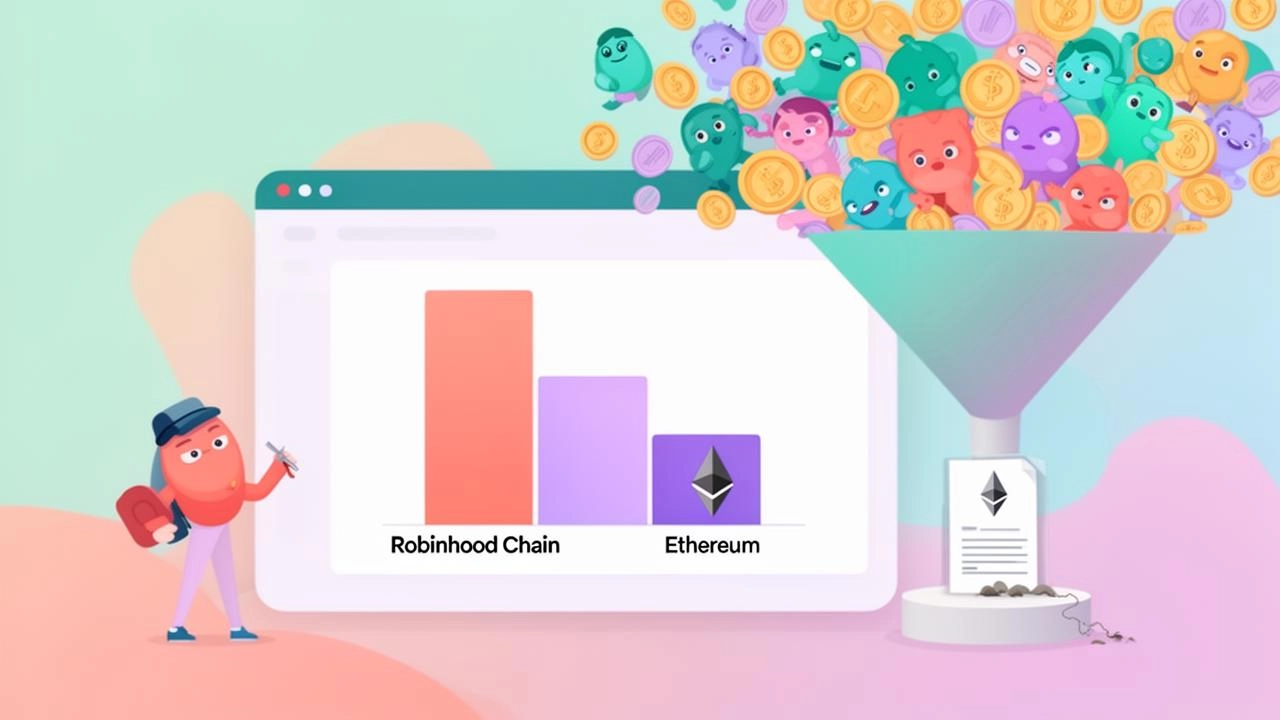
A two-month-old blockchain launched by Robinhood Markets has overtaken Ethereum in daily application revenue, a milestone driven almost entirely by speculative memecoin trading rather than the tokenized-stocks mission the network was built around.
Applications running on Robinhood Chain generated $2.66 million in revenue during the 24 hours ending August 31 placing the network second among all tracked chains. Only Solana earned more at $5.07 million. Ethereum mainnet applications brought in $1.27 million over the same window, while Hyperliquid L1 collected $1.7 million and Base recorded $438,436
The revenue figure measures fees that decentralized applications collect from users, not income booked by Robinhood itself. The company opened the network to the public on July 1 at an event in London, positioning it as infrastructure for tokenized stocks and real-world assets. Two months later, the busiest thing on the chain is a launchpad that produced a record 22,600 new tokens in a single day.
Three protocols accounted for approximately 88% of all application revenue during the window. GMGN, a trading terminal optimized for fast memecoin execution, led with $1.11 million. Pons, the chain’s dominant token launchpad, followed at $930,587. Uniswap collected $306,877. Two of the three are pure speculation infrastructure.
The concentration is stark. On August 30, users deployed 22,600 tokens through Pons alone, up more than 40% from the previous day. Each new token typically generates a burst of buying and selling immediately after launch, compounding fee revenue quickly. Ethereum mainnet, by contrast, processes fewer but larger transactions, and its application layer earns less per unit of user attention because base gas costs push small speculative activity toward cheaper networks.
| Chain | 24-Hour App Revenue (Aug 31, 2026) |
|---|---|
| Solana | $5.07M |
| Robinhood Chain | $2.66M |
| Hyperliquid L1 | $1.70M |
| Ethereum | $1.27M |
| BSC | $886,103 |
| Polygon | $747,328 |
| Base | $438,436 |
Note: Figures from DeFiLlama’s rolling 24-hour dashboard as of August 31, 2026.
Robinhood Chain also set records across other activity metrics on August 30. The network processed 5.52 million transactions, an all-time high, while decentralized exchange volume reached roughly $875 million. Uniswap dominated that trading, with approximately $432 million flowing through its newest v4 iteration and another $357 million through v3.
The underlying technology explains part of the fee dynamic. Robinhood Chain is an Ethereum Layer-2 built on Arbitrum’s Orbit stack, with roughly 100 millisecond block times and ETH as its native gas token. Every transaction fee settles in ether, meaning Robinhood’s roughly 27 million customers become de facto ETH users regardless of whether they chose to hold the asset. Fund manager Tom Lee has argued this arrangement treats ETH as a medium of exchange rather than a speculative position.
A Monopoly Inherited by Default
Pons did not earn its dominant position gradually. In the weeks after mainnet launch, a competing protocol called Noxa captured nearly all token issuance on the chain before abruptly halting operations. Pons absorbed that flow and now functions as the effective monopoly on token deployment infrastructure.
The concentration creates a single point of dependency. If Pons stalls the way Noxa did, a substantial share of the chain’s application revenue could disappear with it. Nothing in the current data suggests a diversified fee base underneath the top three names.
Pons routes 80% of protocol fees into automated buybacks that burn its PONS token. The team said on August 29 that 29% of the original one billion supply had been retired, and the token traded at a record $0.39 on August 30.
A second structural change landed days before the revenue spike. PAIR, a protocol operating on the chain, shipped its V5 update introducing what it calls multipool RWA launchpads. These let users issue tokens tied atomically to Uniswap v4 pools backed by oracle-priced baskets of tokenized equities such as Apple, Tesla or Nvidia. That product cleared $26 million in volume on August 31 – small next to the headline numbers, but the only piece of current activity resembling the original tokenized-assets mandate.
Robinhood Chain’s volume-to-locked-capital ratio reveals how the revenue is being generated. Approximately $1.31 billion in DEX volume passed through a chain holding only about $727 million in total value locked. Every dollar resting on the network turned over roughly 1.8 times in a single day.
That pattern is not inherently negative, but it defines what the revenue figure actually represents. A relatively modest capital base moves aggressively through GMGN, Pons and Uniswap, generating fees on each pass. Deep liquidity does not build under those conditions, and thin pools amplify slippage for anyone entering a position with size. Some on-chain analysts have cited daily volumes as high as $1.34 billion, which widens the ratio further.
The record was set without a single US account. Robinhood has extended access to more than 190 tokenized stocks and ETFs across 120 countries, while American retail investors remain excluded under current SEC boundaries. The activity now setting records comes entirely from European and emerging-market users, meaning the chain’s largest potential demand pool has yet to touch it.
The company’s exposure to this revenue is indirect and strategic. A network that attracts developers and volume strengthens the case for Robinhood’s broader on-chain monetization plans, including the tokenized-equities business it built the chain to host. But none of the $2.66 million reaches Robinhood’s income statement.
For the tokenized-assets thesis, the next measurable signal is whether PAIR’s multipool volume and similar RWA-linked issuance grow as a share of total fees, or whether the launchpad cycle exhausts itself the way comparable memecoin waves have on Solana and BSC. Robinhood’s next earnings disclosure, and any SEC movement on tokenized equities for US accounts, will determine whether the chain converts a speculative surge into the infrastructure it was announced as.
Once added, BigGo Finance appears first in Google Search Top Stories, so you get the broadest, most up-to-the-minute, and most comprehensive global financial news first.
Source: finance.biggo.com