

Don't want to trade it yourself?
Our desk runs DEX portfolios on profit share.
Afghanistan looked set to be an unlikely success story for Bitcoin, but the arrival of the Taliban put an end to that.
The Taliban Bitcoin ban drove a burgeoning crypto market underground, but the asset and stablecoins had proven useful in a system where banking and remittances had failed.
Why Did the Taliban Ban Bitcoin and Cryptocurrency in Afghanistan?
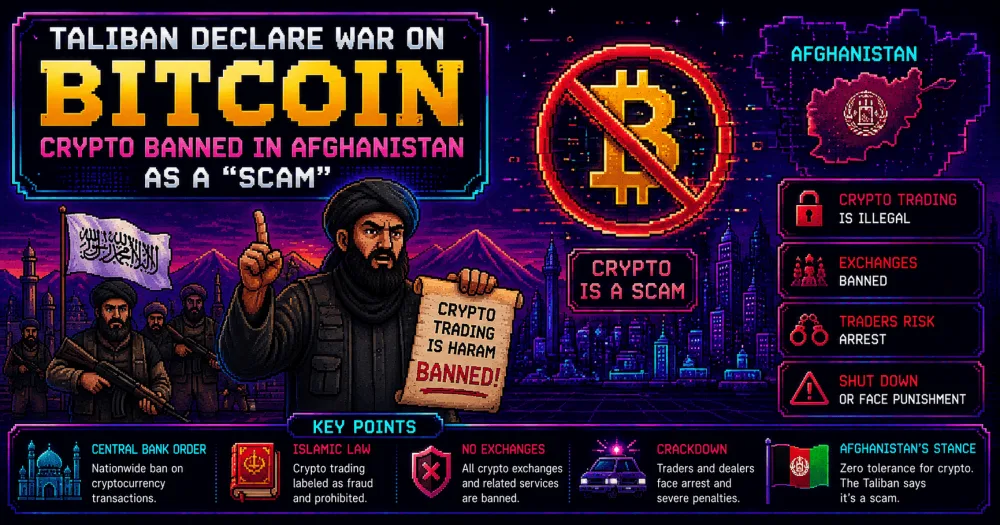
Afghanistan’s Central Bank Orders a Nationwide Crypto Ban
Da Afghanistan Bank took action against online trading, tightening a nationwide cryptocurrency ban, and issuing statements claiming there was no legal framework for licensed trading.
The Afghanistan crypto ban applied to businesses and individual traders and warned that those who didn’t comply would face prosecution.
Why the Taliban Called Crypto Trading “Fraudulent”
The Taliban labeled digital currency trading as fraudulent and damaging to ordinary users; it claimed that it led to losses and encouraged fraud and scams.
This rhetoric formed the backdrop to the Taliban cryptocurrency ban and the crackdown on Bitcoin, other tokens, and trading platforms.
Bitcoin, Crypto and the Islamic Finance Question
Islamic finance was also cited as a justification for the Taliban’s actions, with officials suggesting that speculation had the nature of gambling and was not sanctioned by sharia law.
The government had examined whether digital assets could be incorporated into Islamic finance but chose instead to ban trading.
Taliban vs. Bitcoin: What Exactly Is Banned in Afghanistan?
Is Bitcoin Illegal in Afghanistan?
Bitcoin trading stands outside of the permitted financial system of Afghanistan, and the central bank does not license crypto businesses.
Is Bitcoin illegal in Afghanistan? Under the current Taliban approach, commercial trading and exchange activity will be banned and prosecuted.
Are Crypto Exchanges Banned in Afghanistan?
Physical crypto brokerages and online exchange activity have been targeted by the authorities. Crypto exchanges in Afghanistan are not permitted to apply for a domestic business license in the country. The Afghanistan cryptocurrency ban therefore provides an obstacle to the main bridge between cash and digital assets. It is extremely difficult for businesses to gain legal access to the system.
What Happens to People Trading Cryptocurrency?
Enforcement has included closures, arrests, and threats of legal action. The crypto crackdown Afghanistan experienced was not simply a regulatory warning. Open traders and crypto businesses can be subject to police attention, prompting much trading activity to move underground.
The Taliban’s Message to Crypto Dealers: Close Shop or Risk Arrest
The message to dealers has been clear – stop operating or face consequences. Police in Herat took action against businesses that continued to operate after the ban was introduced. Local operators had three options: to close, to withdraw from the market, or to face arrest.
The Taliban Arrested Crypto Dealers as the Crackdown Escalated
How Many Crypto Traders Were Arrested?
Initial enforcement in Herat resulted in thirteen reported arrests, most of whom were released on bail, with more than twenty crypto businesses closed by the authorities.
Dealers elsewhere also faced increasing pressure, with the Taliban’s arrests of crypto traders sending a warning signal across the country.
Why Herat Became a Major Crypto Hub
Herat had become Afghanistan’s most visible crypto center, with four of the six known crypto brokerages based in the city prior to the crackdown.
Its proximity to Iran also meant that it served as an important trading city, with dealers facilitating the conversion of cash and digital assets.
More Than Bitcoin: Stablecoins Were a Lifeline for Afghan Users
While Bitcoin may have garnered headlines, many Afghan users favored dollar-linked stablecoins over volatile crypto assets.
A stablecoin could offer a more reliable medium for payments and savings, as well as allowing users to maintain their purchasing power and move money around internationally.
| Metric | Before the Crackdown | After the Taliban Ban | What It Shows |
|---|---|---|---|
| Monthly Crypto Inflows | Over $150 million at the peak | Below $80,000 on average | Visible crypto activity collapsed |
| Crypto Brokerages in Herat | Several active businesses | More than 20 shops closed | Enforcement targeted physical access points |
| Crypto Traders Arrested | No large-scale crackdown | At least 13 reported arrests in Herat | Trading carried real legal risk |
| Bitcoin Access | Available through local dealers and P2P markets | Severely restricted | Bitcoin remained technically usable |
| Stablecoin Use | Popular for savings and remittances | Driven largely underground | Users lost an important dollar alternative |
| Exchange Activity | Growing after the 2021 takeover | Effectively prohibited | The formal crypto market disappeared |
| P2P Trading | Widely accessible | Possible but risky | Decentralized transfers proved harder to stop |
| Global Bitcoin Network | Unaffected | Unaffected | A national ban could not shut down Bitcoin |
Bitcoin Wasn’t Just About Getting Rich in Afghanistan
Why Afghans Turned to Crypto After the Taliban Takeover
A wave of sanctions, the freezing of reserves, and banking restrictions following the 2021 Taliban takeover resulted in a difficult financial system for ordinary citizens.
Afghans turned to crypto as a means of making payments where other systems had failed.
Bitcoin and Stablecoins as a Way Around a Broken Banking System
Crypto could provide a means of moving money that did not rely on domestic banks, as users could receive digital assets directly into a wallet. Stablecoins could facilitate remittances and savings, and Bitcoin represented another option outside the traditional financial system.
When “Digital Gold” Becomes an Escape Hatch
The narrative of “digital gold” takes on new meaning for residents of a country with limited banking options.
Self-custody can provide a form of financial independence that is unavailable to ordinary residents of more developed economies. A Bitcoin owner can look after their own assets without the intervention of a domestic banking system.
The Taliban Didn’t Quite Love the Competition
Why Crypto Was Useful to People Trying to Move Money
Cryptocurrency could provide people with a means of transferring value that did not rely on permission from a local bank.
The same characteristic reduced the level of control that governments could exercise over individuals. The same characteristic reduced the level of control that governments could exercise over individuals.
Sanctions, Banks and the Rise of Crypto in Afghanistan
Afghanistan was increasingly isolated from the global financial system, with foreign reserves frozen and banking links severed.
Crypto could provide a way in which users could receive money without relying on banks or traditional remittance channels.
From Financial Lifeline to Financial Forbidden Fruit
The same technology that had provided a lifeline to ordinary residents rapidly became prohibited. The shift was rapid; cryptocurrency activity in Afghanistan went from a boom to bust scenario, with dealers who had built up businesses suddenly finding themselves the target of enforcement.
How Badly Did the Taliban’s Crypto Ban Hit Afghanistan?
Afghanistan’s Crypto Market Collapsed After the Crackdown
It was a spectacular fall from grace. Afghanistan had been one of the global leaders in grassroots crypto adoption before the ban was enforced. After increased enforcement, this visible activity almost disappeared, with the Afghanistan crypto market serving as a useful indicator of the impact of the crackdown.
From More Than $150 Million a Month to Less Than $80,000
On-chain inflows briefly exceeded $150 million after the takeover. Before it, average monthly receipts stood near $68 million.
Later, monthly activity averaged below $80,000 – a fall of more than 99% from the temporary peak.
Crypto Adoption in Afghanistan Falls Off a Cliff
The situation reflects more than a bear market – fear of enforcement has decimated visible trading infrastructure. Exchanges have been closed, dealers have disappeared, and users have been denied access to cash. The Taliban crypto crackdown has essentially driven crypto out of the mainstream.
Is Bitcoin Really a “Scam”?
What the Taliban Says About Cryptocurrency
Taliban officials associated cryptocurrency with fraud, speculation, and gambling, and rejected its place within Islamic finance.
These views are the basis for the prohibition, but they do not provide an accurate technical assessment of every digital asset on offer.
What Bitcoin Actually Is — and What It Isn’t
Bitcoin is a decentralized digital monetary network with a capped maximum supply. There is no company issuing BTC▲$62,630.00 or guaranteeing returns to investors.
Bitcoin can fall sharply in price and lead to losses, but price volatility is not a characteristic of a scam.
Crypto Scams Are Real, But Is Bitcoin the Scam?
While crypto scams certainly exist, Bitcoin operates in a fundamentally different manner to fraudulent investment schemes. Fraud often takes place at the level of individual projects, or through phishing or other means. The rules of Bitcoin are open and transparent, and its supply is not artificially inflated.
Could Afghans Still Use Bitcoin After the Taliban Ban?
Can You Still Buy Bitcoin in Afghanistan?
A person with internet access and a willing counterparty can still receive Bitcoin. The danger of legal action makes the process far more complicated, however.
So, can you use Bitcoin in Afghanistan? While the network is accessible, local trading can be subject to severe enforcement risk.
The Role of P2P Trading and Hawala
The use of P2P trading can make enforcement more difficult, as buyers and sellers can arrange a direct transaction and settle in cash.
Afghanistan also has hawala networks that facilitate informal money transfers. The combination of such systems with crypto makes enforcement challenging.
Why Banning Crypto Is Easier on Paper Than on the Blockchain
A government can close exchanges, arrest traders, and restrict access to websites, but it cannot turn off the Bitcoin network from within one country.
Individuals can continue to hold and receive Bitcoin, but the challenge is often in turning it into local currency without drawing attention.
What the Afghanistan Crypto Ban Means for Bitcoin
Can Governments Actually Kill Crypto by Banning It?
Governments may be able to kill local liquidity and make crypto inaccessible and difficult to use, but Afghanistan is a prime example of the limits of such an approach.
While local trading and exchange activity has been crushed, Bitcoin itself continues.
Afghanistan Is an Extreme Test of Bitcoin’s Censorship Resistance
Afghanistan is an extreme test of Bitcoin’s censorship resistance, as the authorities have gone to great lengths to remove it from the system.
While they have succeeded in shutting down much of the visible market infrastructure, they cannot remotely switch off every self-custodied wallet.
The Irony: A Bitcoin Ban Could Prove Bitcoin’s Point
The Taliban ban on Bitcoin illustrates why people value decentralized money. Bitcoin is important when mainstream finance is unavailable or uncertain.
The ban serves as a reminder of both the limitations of central authority and the resilience of the decentralized system.
Taliban vs. Bitcoin: Who Actually Won?
The Crypto Market Lost — But Bitcoin Didn’t Disappear
The local crypto industry has clearly lost out – trading volumes have collapsed, and businesses have been forced to close or face arrest.
Bitcoin itself did not disappear, however – any individual with the private keys can continue to hold BTC, even when public exchange activity has become dangerous.
What Afghanistan’s Crackdown Says About Crypto Freedom
Financial freedom requires more than just technology – users need access to the internet and privacy, liquidity, and a way of exchanging digital assets for cash.
Decentralization doesn’t remove every obstacle, but it does make total prohibition much harder.
From “Scam” to Financial Lifeline: The Strange Bitcoin Story in Afghanistan
Bitcoin in Afghanistan has an ironic history – the technology that was banned had proved invaluable to ordinary residents.
That is not to say that Bitcoin is risk-free, but it illustrates why unstable economies may value the characteristics that more developed nations take for granted.
Why Did the Taliban Ban Cryptocurrency?
Officials associated cryptocurrency with fraud, speculation, gambling, and issues with Islamic finance. They also wished to halt unlicensed online trading.
Is Crypto Illegal in Afghanistan?
The Taliban authorities prohibit crypto trading and do not allow exchanges to apply for a normal license.
Can U.S. or Foreign Platforms Serve Afghan Users?
It depends on sanctions, compliance rules, platform policies, and local law – many global services are restricted in high-risk jurisdictions.
What Happened to Crypto in Afghanistan?
Visible activity has collapsed after the crackdown, with trading volumes falling sharply and exchanges closing.
Can the Taliban Completely Stop Bitcoin?
They can severely restrict its use locally, but they cannot switch off the global network or every self-custodied wallet.
Source: bitcoinfoundation.org