

Don't want to trade it yourself?
Our desk runs DEX portfolios on profit share.
Currencies38842
Market Cap$ 2.74T-0.24%
24h Spot Volume$ 34.23B-0.70%
DominanceBTC57.66%+0.02%ETH10.95%+1.46%
ETH Gas0.04 Gwei
FeaturedSolanaTechnologyCardanoGovernance
Aug 27, 2026
5min read
byOluwapelumi Adejumo
forCryptoSlate
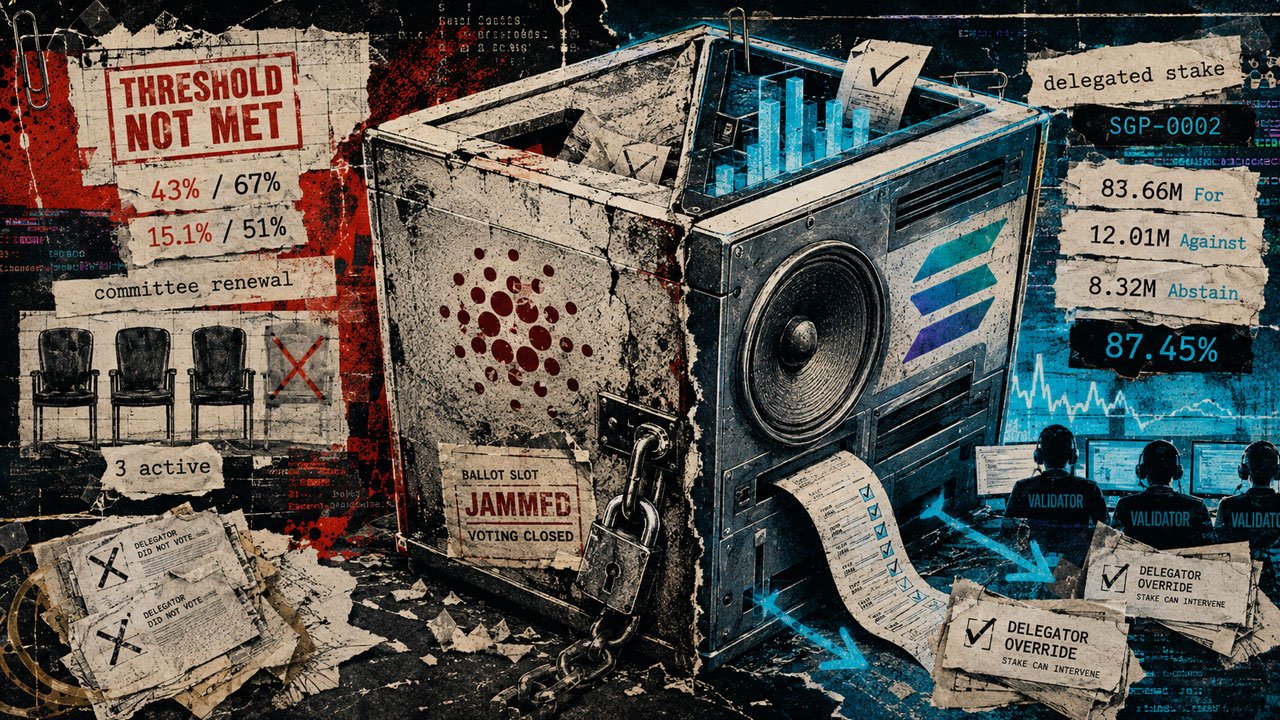
Cardano and Solana expose competing governance weaknesses: Cardano’s dual-constituency system risks a near-term bottleneck after an Aug. 26 snapshot showed Update Constitutional Committee 2026 support at 43% among DReps (vs 67% required) and 15.1% among stake pool operators (vs 51% required), risking four committee seats expiring by the Sept. 1/epoch deadline and potentially delaying upgrades. Solana lowers turnout risk by letting validators vote with delegated stake—SGP-0002 recorded ~83.66M SOL For, 12.01M Against and 8.32M Abstain (87.45% support among decisive votes)—but creates an agency problem as validator-aligned firms like Solana Company (staking revenue $2.512M of $2.526M, ~99.4%) may have economic conflicts and the outcome is clouded by inconsistent quorum rules, leaving token policy and staking governance uncertain.
See what traders are focused on
Cardano and Solana are testing two competing approaches to on-chain governance, with one exposing the cost of voter absence and the other shifting more power to default representatives who may have their own economic interests.
Cardano’s constitutional committee renewal requires separate approval from delegated representatives, or DReps, and stake pool operators. Solana instead allows validators to cast governance votes using the active stake delegated to them unless individual stakers override that choice.
The distinction is becoming visible in simultaneous votes on both networks.
Cardano faces the more immediate risk. An Aug. 26 snapshot showed support for its committee renewal below the required thresholds among both DReps and stake pool operators, creating the possibility that four committee terms expire without replacements.
Solana reduces that kind of participation bottleneck by making validators default voting agents. But its current governance vote shows the tradeoff: stakers who do nothing effectively allow validators to exercise governance weight associated with their delegated stake, even when those validators may have financial interests affected by the proposal.
Both systems therefore confront the same underlying problem from different directions. Cardano leaves inactive voters silent. Solana lets an existing delegate speak for them.
Cardano’s governance risk is already measurable
A DRepTalk snapshot accessed Aug. 26 showed Cardano’s Update Constitutional Committee 2026 proposal with 43% DRep support, below the required 67%, while stake pool operator support stood at 15.1% against a 51% threshold.
Each group must independently clear its requirement. Stronger participation by one cannot offset a shortfall in the other.
The vote carries a fixed consequence because four committee terms expire at epoch 799, while the maximum allowable term length means replacements must be enacted in epoch 653. Published material identifies Sept. 1 as the relevant deadline.
If the proposal fails, Cardano would be left with three active constitutional committee members, below the reported five-member minimum required for committee-dependent governance actions.
That would not stop block production or freeze the entire network. It would, however, leave the committee unable to ratify actions that require its approval until governance restores sufficient membership.
Intersect has warned that such a disruption could affect the timing of the Dijkstra upgrade, though that does not automatically cause a delay.
Cardano’s design makes the cost of inaction explicit. Its governance system requires two separate constituencies to express enough support, preserving each group’s independence while also creating two opportunities for insufficient participation to block continuity.
Solana reduces turnout risk, then inherits an agency problem
Solana’s model lowers the participation burden by allowing validators to vote with the stake already delegated to them.
Eligible stakers can override a validator’s choice for an individual stake account. When they do, that stake is removed from the validator’s effective tally and applied directly to the staker’s own selection.
That mechanism was active during SGP-0002, a proposal seeking support for faster SOL disinflation.
An Aug. 26 Validator Info snapshot showed 83.66 million SOL voting For, 12.01 million Against, and 8.32 million Abstain. Among decisive votes, support stood at 87.45%.
Direct delegator overrides were visible but small compared with the roughly 104 million SOL represented in the tally. Validator Info listed 308 delegator voters, with only a fraction of the overall voting weight directly reassigned.
The override mechanism is therefore being used. The current vote does not yet show whether large numbers of passive delegators would intervene when they disagree with their validator.
That question becomes more significant when validators have an economic stake in the policy under consideration.
Solana Company, a publicly traded SOL treasury firm, said it opposed SGP-0002 on timing and policy-stability grounds. Its second-quarter filing showed $2.512 million in staking revenue out of $2.526 million in total revenue, meaning staking accounted for about 99.4% of quarterly revenue.
The proposed policy would accelerate annual disinflation from 15% to 30%, reducing projected issuance by about 18.9 million SOL over six years and bringing the network to its 1.5% terminal inflation floor in roughly 2.8 years instead of 5.7 years.
Those facts establish an economic exposure, but they do not prove misconduct or that financial incentives determined the company’s vote. Stakers also retain the ability to override validator choices.
Solana’s rule conflict adds another layer of uncertainty
The Solana vote is complicated further by conflicting public descriptions of what constitutes passage.
The Solana governance FAQ says one-third of network stake must participate and two-thirds of participating stake must vote For. The governance proposal repository instead says there is no quorum requirement and that For must receive two-thirds of For plus Against, excluding Abstain.
Under the repository rule, the observed vote clears the support threshold. Under the FAQ and Validator Info display, participation remained below the one-third line.
That leaves the same tally open to two different interpretations and makes the result difficult to assess until the applicable rule is reconciled.
Even a favorable result would not immediately change SOL issuance. SGP-0002 would establish policy direction, while the underlying SIMD-0550 proposal would still need to move through implementation before any consensus-affecting change could be activated.
Both systems relocate the cost of voter apathy
The current votes show that delegation changes the form of participation risk rather than removing it.
Cardano bears the cost directly when voters fail to show up. Its immediate danger is concrete: two constituencies remain below required thresholds ahead of a fixed deadline, with committee capacity at stake.
Solana reduces that risk by allowing validators to represent passive holders, but the model shifts more responsibility toward oversight. Delegators must monitor the agents voting with their stake and intervene when their preferences diverge.
Cardano therefore faces a clearer near-term governance threat, while Solana raises a longer-term question about representation and incentive alignment.
The next results will sharpen that contrast. Cardano must determine whether DReps and stake pool operators can mobilize before the committee deadline, while Solana still needs to establish which voting rule governs SGP-0002 and how much weight delegator overrides ultimately carry.
Both systems arrive at the same unresolved question from opposite directions: whether on-chain governance can remain effective when most tokenholders prefer not to participate.
Source: cryptorank.io