


Don't want to trade it yourself?
Our desk runs DEX portfolios on profit share.

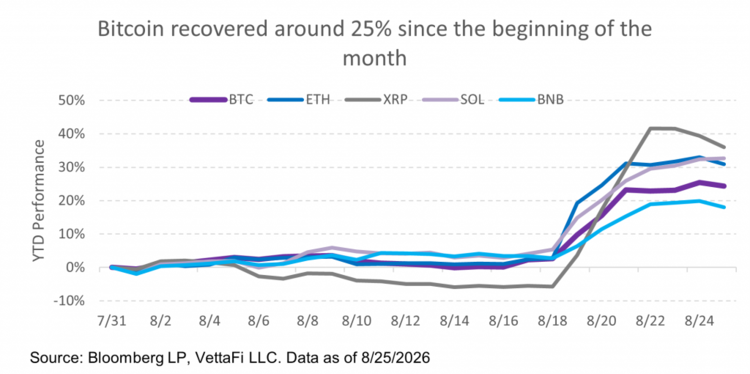
Bitcoin has rebounded sharply from the low-$60,000s to around $80,000, gaining nearly 20% last week in one of its strongest weekly moves in years. The rally appears to reflect several forces working together: improving macro conditions, short covering, renewed regulatory optimism, and stronger demand through U.S.-listed crypto ETFs.
Key Takeaways:
- Bitcoin’s rebound reflects macro tailwinds, short covering, regulatory optimism, and renewed spot ETF demand.
- Stronger Bitcoin and Ether ETF inflows suggest investor interest may be returning after months of weakness.
- Rising flows into Solana, XRP, and other altcoins point to broader crypto risk appetite.
Content continues below advertisement
Macro Backdrop Helps Revive the Debasement Trade
One of the most important catalysts came from an unexpected shift in U.S. Treasury policy. On August 19, the Treasury announced that it would at least double the size of its liquidity-support buybacks for longer-dated Treasuries, increasing the maximum from $2 billion to at least $4 billion per operation, beginning September 9. The Treasury described the change primarily as an effort to improve liquidity in longer-dated securities rather than a broader monetary stimulus program.
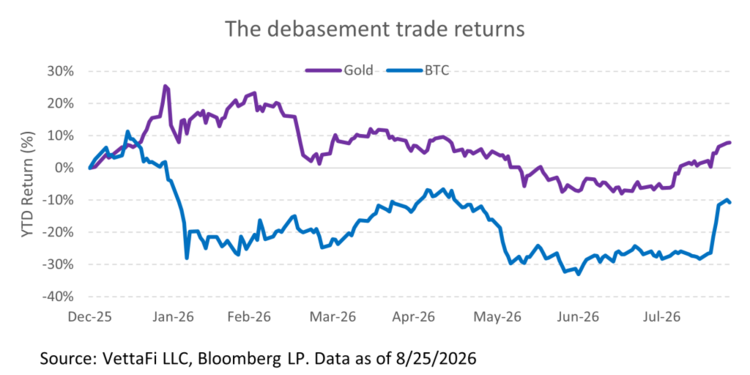
Still, the announcement helped revive the so-called “debasement trade.” Concerns surrounding large fiscal deficits, rising government debt, and potentially greater intervention in the Treasury market weighed on the dollar, which fell nearly 1% over the week, while assets commonly viewed as alternatives to fiat currencies, including gold and Bitcoin, rallied.
That backdrop is particularly relevant for Bitcoin, which has historically been sensitive to interest rates and dollar movements. Lower long-term yields can make non-yielding assets relatively more attractive, while a weaker dollar can strengthen demand for assets viewed as alternatives to traditional currencies.
The rally was also amplified by traders who had been betting against Bitcoin. As prices began to rise, some short sellers were forced to buy Bitcoin to close their positions, adding further upward pressure and helping accelerate the move toward $80,000.
Macro catalysts and short covering can drive sharp price moves, but they do not necessarily create lasting demand. For Bitcoin’s rebound to prove more long-lasting, continued ETF inflows and further progress on the regulatory front will likely be important.
Regulatory Momentum Adds Another Tailwind
At around the same time, the U.S. regulatory backdrop has become more constructive. President Trump reinforced his support for crypto market structure legislation at an August 19 White House meeting with industry executives, including Coinbase CEO Brian Armstrong, calling on Congress to pass a “fair version” of the CLARITY Act.
Armstrong has argued that legislation is important because it would make recent regulatory progress more durable rather than leaving it dependent on the policies of the current administration. The SEC and CFTC have also continued moving toward more crypto-friendly rules and frameworks under their existing authority, providing the industry with greater clarity in the near term.
Still, the path toward legislation remains uncertain. The Senate had hoped to advance the CLARITY Act but pushed action into September amid disagreements over ethics provisions, stablecoin rewards, banking competition, and other parts of the bill. The delay highlights an important distinction: rule makers have become considerably more supportive of crypto, but translating that support into lasting legislation remains more difficult.
In the meantime, regulators can continue making changes without Congress, but those actions may also be easier for a future administration to reverse. That helps explain why passage of the CLARITY Act remains important to the industry even as the broader regulatory environment improves.
Spot Bitcoin ETF Demand Strengthens
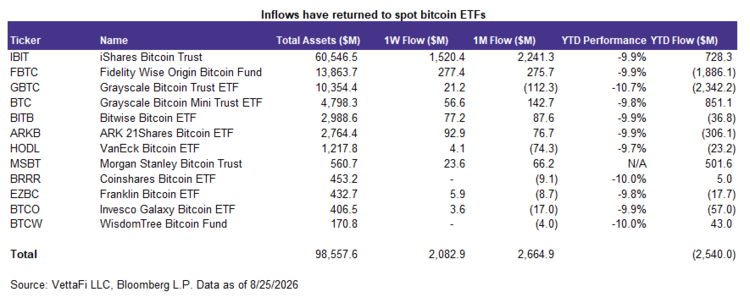
ETF flows provide another encouraging signal. U.S. spot Bitcoin ETFs took in roughly $2.0 billion last week, their strongest week in 10 months, while trading volume more than tripled from the prior week to approximately $22 billion.
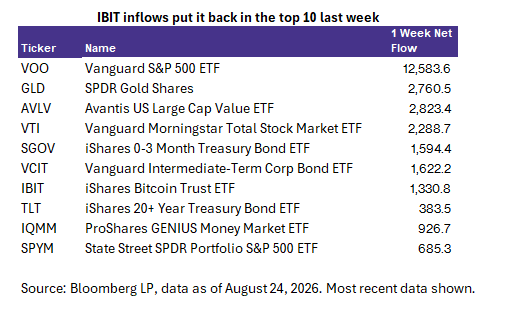
BlackRock’s iShares Bitcoin Trust
(IBIT) captured the majority of those inflows and returned to the top 10 U.S. ETFs for weekly flows along with large broad-based funds. That is notable following several months of significant outflows from both IBIT and the broader spot Bitcoin ETF category and suggests investors are becoming more willing to add exposure as sentiment improves.
Still, one strong week does not necessarily signal a true reversal. Spot Bitcoin ETFs remain around $2.5 billion in net outflows for 2026, making continued inflows an important indicator of whether the latest rally is attracting longer-term capital rather than simply recovering money that left during the recent selloff.
Investor Appetite Spreads Beyond Bitcoin
Spot Ether ETFs also saw a significant rebound, attracting about $697 million last week, their strongest week of 2026. The ETFs still remain slightly negative for the year, showing how much ground the category still has to recover.
Interest has also spread further down the crypto market. U.S.-listed ETFs outside Bitcoin and Ether led by roughly $90 million for Solana ETFs like the Bitwise Solana Staking ETF
BSOL). XRP ETFs have now recorded six consecutive weeks of inflows, while Solana ETFs have had eight consecutive positive weeks. Other smaller products, including Hyperliquid ETFs, also saw positive flows. Hyperliquid ETFs like the Grayscale Hyperliquid Staking ETF
(HYPG) have seen strong interest since their recent launch, due to Hyperliquid’s easy-to-understand use case.
Rather than investors returning only to Bitcoin as a perceived crypto safe haven, flows into Ether, Solana, XRP, and other newer products suggest risk appetite is broadening across the digital asset market as prices recover and the regulatory outlook improves. I address this in more detail in my latest quarterly update.
Bottom Line:
The recent rebound looks broader than a single macro-driven rally. The Treasury buybacks and short covering may have provided the initial spark, but improving regulation and stronger ETF demand could be more important for determining whether the recovery can continue. The next test will be whether those ETF inflows persist and whether regulations can turn its increasingly supportive stance toward crypto into long-lasting legislation.
For more news, information, and analysis, visit the Crypto Content Hub.
Loading Articles…
Source: etfdb.com
5 Comments
Pingback: Is the August rally starting to crack? – xpertsstudio
Pingback: Solana Price Prediction Points To $110 As Daily Active Addresses Hit 5 Million – xpertsstudio
Pingback: Bitcoin and ethereum prices today, Thursday, August 27, 2026: Down from highs, but prices holding strong – xpertsstudio
Pingback: The Supply Wall Between $81,000 and $86,000 – xpertsstudio
Pingback: Bitcoin is trapped between $75,000 and $80,000 ahead of a massive Friday derivatives settlement | Bitcoin Market – xpertsstudio