

Don't want to trade it yourself?
Our desk runs DEX portfolios on profit share.
Add to Google Preferred Sources
Global cryptocurrency market capitalization surged by roughly $500 billion in a single week, breaking above $2.7 trillion for the first time in about three months. <a href="https://xpertsstudio.com/bitcoin-slips-below-80000-as-rally-cools/” title=”Bitcoin Slips Below $80,000 as Rally Cools”>Bitcoin climbed 22.5% week-over-week while Ethereum gained 28.6%, and trading volume at South Korean exchanges Upbit and Bithumb jumped 192.4% and 116.1%, respectively. The rally was driven by a combination of factors: the U.S. Treasury Department’s expanded Treasury buyback program, the SEC’s new crypto regulatory framework, and demand for dollar alternatives. In South Korea, the “reverse Kimchi premium” that had persisted for over 100 days has dissipated, with a Kimchi premium re-emerging. However, experts caution that liquidity and interest rate conditions differ markedly from 2021, and whether this marks the start of a full-fledged rotation remains to be seen.
Key Elements
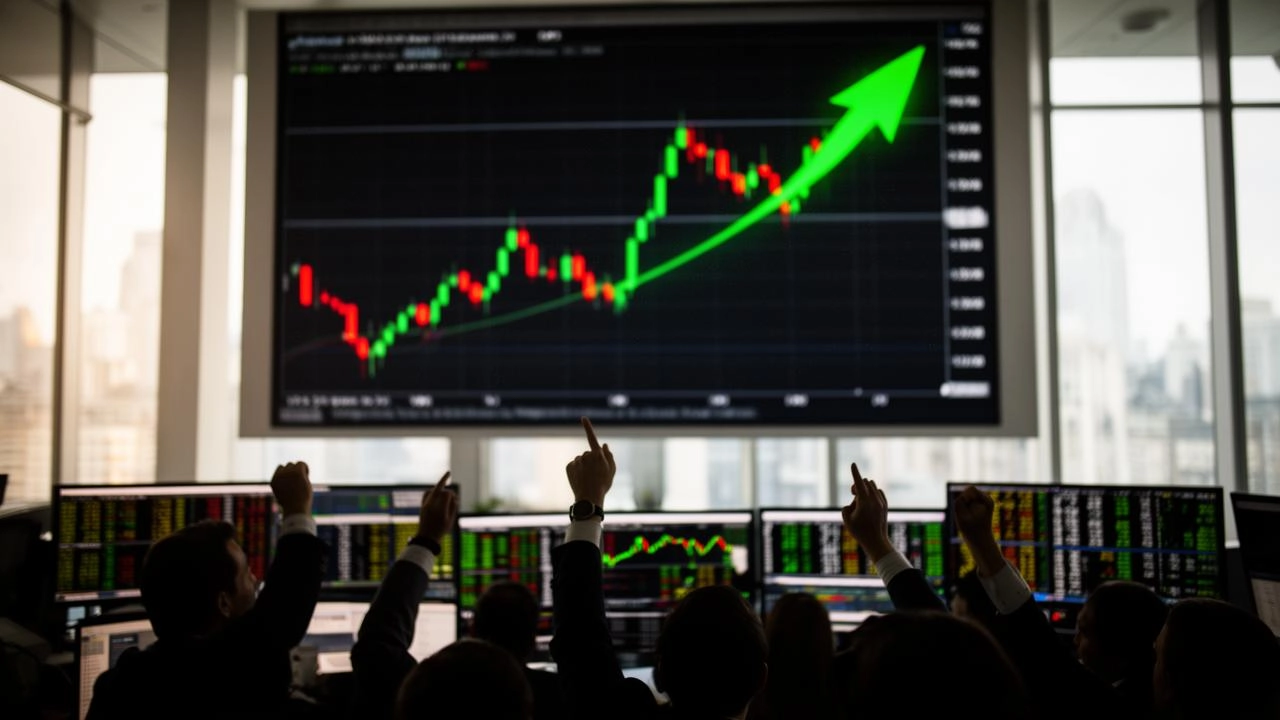
Global cryptocurrency market capitalization swelled by nearly $500 billion (approximately 692 trillion won) in a single week, surpassing $2.7 trillion for the first time in roughly three months. The investment fervor that had been heating up equity markets now appears to be spilling over into digital assets. Attention is focused on whether the “stocks → crypto” rotation seen during the 2021 bull market will repeat itself.
As of 1:54 p.m. on the 26th, global crypto market cap stood at $2.65 trillion (approximately 3,667.5 trillion won) it had climbed to $2.71 trillion (approximately 3,750.6 trillion won), breaking through the $2.7 trillion threshold. That represents a 23% increase from $2.19 trillion a week earlier
Major cryptocurrencies rose in tandem as buying pressure spread across the market. Bitcoin (BTC) was up 22.5% week-over-week, while Ethereum (ETH) gained 28.6% over the same period. XRP and Solana (SOL) surged 43.4% and 25.7%, respectively.
Trading volume at South Korean exchanges also expanded significantly. Upbit’s 24-hour trading volume reached $1.129 billion (approximately 1.6 trillion won), up 192.4% week-over-week On the 22nd, it had spiked to $3.33 billion (approximately 4.6 trillion won). Bithumb’s trading volume rose 116.1% over the week
The rally was fueled by a combination of expectations for expanded U.S. liquidity, regulatory easing, and demand for dollar alternatives. The U.S. Treasury Department’s expansion of its long-term Treasury buyback program served as a tailwind for both equities and crypto. The Trump administration’s accelerated push to bring digital assets into the regulatory fold has also accelerated capital inflows, analysts say. Demand to accumulate Bitcoin as a hedge against dollar depreciation further amplified the upside.
“The Trump administration’s deregulatory moves, combined with demand for alternative assets to hedge against dollar weakness, drove the strong rally,” said Kim Nam-woong, CEO of Four Pillars.
There is also growing speculation that retail investors who had been focused on South Korea’s stock market may shift their attention to crypto. The KOSPI, which broke above the 9,000 mark on a closing basis in June, has since trended downward, trading at 6,869.23 as of 2:13 p.m. Investors who believe the stock market has peaked may look to crypto for higher returns.
“The increase in crypto exchange volume reflects the fact that crypto volatility has outpaced equities,” Kim explained. “It appears that investors who previously traded digital assets are returning to the market.”
Reverse Kimchi Premium Dissipates… Sign of Recovering Investor Sentiment
The “reverse Kimchi premium” — the longest-running in South Korean crypto market history — has finally dissipated, with a Kimchi premium re-emerging. This shift is attributed to the won-dollar exchange rate stabilizing on a downward trajectory and a recovery in digital asset investor sentiment.
According to digital asset data site KIMPGA, Bitcoin was trading at 109.86 million won (approximately $79,000) on Upbit as of 10 a.m., about 0.644% higher than the price on Binance, the world’s largest digital asset exchange.
At the same time, Tether (USDT) was trading at 1,391 won (approximately $1) on Upbit, about 0.592% more expensive than on Binance. As the won-dollar exchange rate fell to 1,383.10 won (approximately $0.9994) based on Seoul Foreign Exchange Brokerage rates, the price of the dollar-pegged stablecoin Tether also dropped below 1,400 won (approximately $1).
The “Upbit Premium Index,” which shows the price gap between CoinMarketCap and Upbit, reflected the same trend. Upbit premiums for Bitcoin and Tether stood at 0.52% and 0.61%, respectively. A value above zero indicates that a premium exists when trading on Upbit.
A Kimchi premium typically forms when South Korean crypto investment enthusiasm runs hotter than overseas markets. South Korea’s digital asset market has a high proportion of retail investors, and arbitrager crypto assets trading at higher prices domestically than abroad
The sharp decline in the won-dollar exchange rate was a major factor in resolving the reverse Kimchi premium. When the exchange rate falls, the won-denominated value of dollar-priced crypto assets on overseas exchanges also declines, narrowing the price gap between domestic and international markets. This, combined with the U.S. Treasury buyback expansion and expectations for regulatory easing, has lifted crypto prices broadly and partially revived investor sentiment.
Previously, South Korean investors had flocked to the booming stock market, while the crypto market languished under regulatory restrictions that limited new service launches, dampening investment interest. As a result, the reverse Kimchi premium — where domestic prices trade below overseas prices — had persisted for more than 100 days.
“The SEC’s announcement of the ‘Regulation Crypto Assets’ framework on the 18th (local time) eased regulatory uncertainty, and the U.S. Treasury’s expansion of medium- and long-term Treasury buybacks has also created a more favorable financial environment,” said Shim Soo-bin, an analyst at Kiwoom Securities.
“Expectations for additional Bitcoin purchases by digital asset treasury (DAT) companies have risen, driven by Strive’s Bitcoin acquisitions and Strategy’s cash-raising efforts, which has shifted crypto market sentiment in a positive direction,” Shim added.
A Different Macro Environment from the 2021 Rotation
A similar pattern emerged in 2021. Crypto investment enthusiasm spread as the KOSPI, which had risen sharply in 2020, peaked in January 2021 and entered a correction phase. In April of that year, Bitcoin surpassed $59,000, and by November it had climbed to the $67,000 range, setting what was then an all-time high.
“In the post-COVID era, abundant liquidity drove a rotation of capital from stocks into crypto,” said Bok Jin-sol, research lead at Four Pillars. “The Bitcoin halving and traditional companies’ entry into the blockchain industry also served as catalysts for the rally.”
“At the time, younger generations in their 20s and 30s were quick to embrace new technology,” Bok added. “Demand for short-term, high-return investments also grew amid surging real estate prices, which played a role as well.”
However, some analysts argue that the current situation cannot be viewed as identical to 2021. While some capital that flowed into equities may migrate to crypto, the macroeconomic environment today differs from five years ago.
“The movement of funds from AI-related assets back into crypto could be interpreted as a rotation,” Bok said. “But in 2021, massive quantitative easing created abundant liquidity, whereas current liquidity and interest rate conditions are different.”
Despite the sharp short-term rally, it may be premature to conclude that the market has entered an overheated phase. The Kimchi premium, which measures how much more expensive domestic prices are compared to overseas, is currently hovering around 0%. Typically, when domestic investment demand overheats, the Kimchi premium expands significantly.
“Investors are still gauging market conditions rather than being convinced of a bull market,” Bok said. “With the Kimchi premium near 0%, it’s difficult to characterize the market as overheated.”
Once added, BigGo Finance appears first in Google Search Top Stories, so you get the broadest, most up-to-the-minute, and most comprehensive global financial news first.
Source: finance.biggo.com